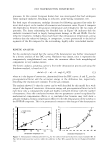
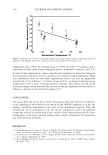
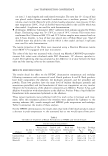
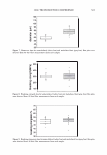
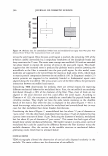
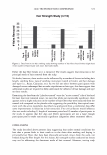
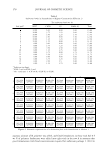
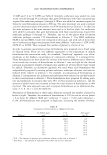
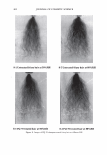
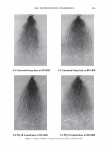
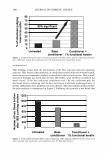
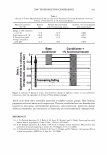
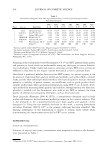
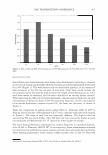
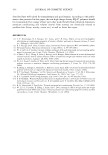
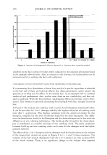
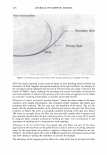
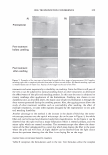
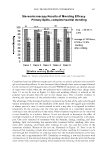
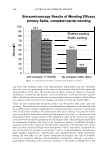
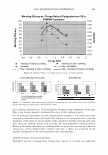
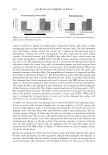
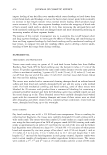
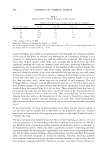
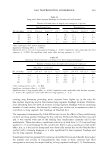
480 JOURNAL OF COSMETIC SCIENCE Table I Long versus Short Segment Breakage and Hair Length* Number of broken hairs at length (cm) (average of 3 replicas) No. of comb strokes 2.54 2.54-6.4 6.4-12.7 12.7 25 28 4 1 50 44.3 4.7 1 1 75 45.7 3.7 1.3 1.3 100 68.7 5.3 0.3 2 * Dry combing at 60 ± 2% RH. Significant difference in breakage by lengths, p = 0.0001. No. of short segment breaks increase with no. of comb strokes (p = 0.001). No. of long segment breaks do not change with no. of comb strokes (p = 0.29). segment breakage most likely occurs primarily by end wrapping and subsequent damage to the ends of the fibers by abrasion and deformation and ultimately breakage occurs primarily by deformation when the ends are sufficiently weakened. The wrapping of distal ends of hairs around comb teeth (1,2), increases the end-peak force and with continued combing the ends are damaged more and more, producing fiber/fiber en- tanglements, and consequently an increase in the number of short segment breaks. The wrapping of hair ends around comb teeth during combing most likely is driven by inertia in which the motion of the comb through the hair near the tip, especially where the hair has a slight curl at the end, produces a tendency for hair fibers to move and curl around the comb teeth (1,2). Since more numerous short segment breaks occurs in the dry than wet state, static charge may also be involved in end wrapping. This end breakage effect is consistent with an effect found by Garcia! et al. (4) who studied cuticle wear patterns among 6 Caucasian subjects who had never chemically treated their hair in which their hair ranged from 30 to 60 cm long. These scientists found that hairs 30 cm long on the scalp had lost many more cuticle cell layers at the distal ends than 60 cm hair at a distance of 30 cm from the scalp. They concluded that "at any common distance from the scalp x, the preservation of the cuticle is better for a longer hair subject", because of greater wear and breakage at the ends. The "distal-end-scale-loss" effect observed by these scientists is most likely due to the end wrapping effect described above. As described earlier (1), long segment breakage most likely involves impact loading of one hair fiber against another and is dependent on the probability that taut crossover hairs occur in snags and one hair impacts over another as the comb breaks through or detangles the snag. The data summarized in Table II shows the effects of hair bleaching on short ( 2.54 cm) and long segment (2.54 cm) breakage when hand combing Caucasian hair dry. The hair was bleached with a peroxide-persulfate commercial bleaching product as described in the Experimental section. These data show a significant increase in both long and short segment breakage by bleaching and significantly more short versus long segment break- age. For the short segment breakage, chemical bleaching increases interfiber friction and makes the ends more susceptible to damage by combing. Therefore, bleaching increases short segment breakage which also increases with the number of comb strokes. For the long segment breakage (Table III), bleaching increases inter-fiber friction thereby in-

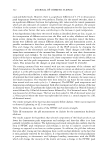
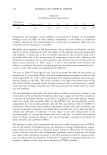
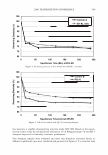
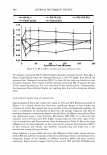
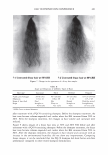
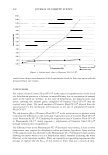
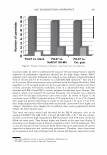
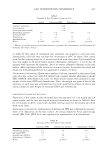
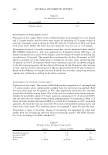
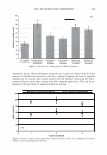
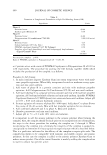
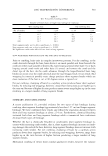
2006 TRI/PRINCETON CONFERENCE Table II Long versus Short Segment Breakage and Number of Comb Strokes* Number of broken hairs at length (cm) (average of 3 replicas) Non-bleached hair Bleached hair No. of strokes 2.54 2.54-6.4 6.4-12.7 12.7 2.54 2.54-6.4 6.4-12.7 12 28 4 50.3 12 5 so 44.3 4.7 1 67.7 11.3 4.7 75 45.7 3.7 1.3 1.3 98.7 22.3 8 100 68.7 5.3 0.3 2 111.3 22.3 3.7 * Dry combing at 60% relative humidity. Significant bleaching effect, p = 0.0001. 481 12.7 3 4.3 3 2.3 Significant short ( 2.54 cm) vs long segment breakage, p = 0.0001. Significant comb stroke effect for short segments, p = 0.0002. No significant comb stroke effect for long segments, p = 0.47. Table III Bleaching Then Conditioner and Long versus Short Fragment Breakage* Number of broken hairs at length (cm) (average of 3 replicas) Bleaching + conditioner No. of strokes 2.54 2.54-6.4 6.4-12.7 25 22.3 3 0.7 so 25 4 0.7 75 26.7 1.3 0.3 100 38.7 4.3 1.3 * Dry combing of hair at 60 ± 2% RH. Significant conditioner effect, p = 0.0001. Bleached hair 12.7 2.54 2.54-6.4 6.4-12.7 1.3 50.3 12 5 0.7 67.7 11.3 4.7 0.7 98.7 22.3 8 1.3 111.3 22 3.7 12.7 3 4.3 3 2.3 Significant short vs long segment effect, p = 0.000 l. Significant comb stroke effect only for short segments, p = 0.0025. No significant comb stroke effect for long segments, p = 0.35. creasing snag formation providing more crossover hairs higher up in the tress for hair-on-hair impacting and in that manner long segment breakage increases. However, since bleaching does not show an increase in long segment breakage with an increasing number of comb strokes, the damage by combing per se does not accentuate nor does it contribute to long segment hair breakage of bleached hair. The experiment summarized by Table III was run to test the effects of hair conditioning on short and long segment breakage by dry combing. Chemically bleached hair was used and it was treated with one of the leading hair conditioners currently sold in the marketplace. These data show a significant reduction in both short ( 2.54 cm) and long segment (2.54 cm) breakage by this conditioner. There is also a significant comb stroke effect, but, as is the case for shampooed non-chemically treated hair and for bleached hair washed with a cleaning shampoo, it is only significant for short segment breakage and not for long segment breakage. Conditioners function primarily by reducing inter-fiber friction and thereby they reduce the number and severity of entanglements that result in those crossover hair fiber arrangements necessary for impact loading in long segment breakage (1,2). Furthermore,
Purchased for the exclusive use of nofirst nolast (unknown)
From: SCC Media Library & Resource Center (library.scconline.org)