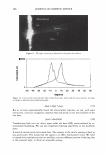
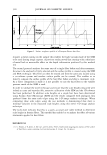
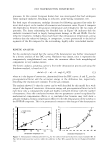
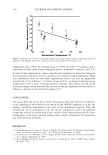
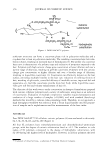
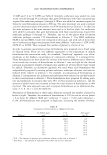
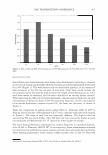
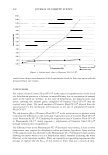
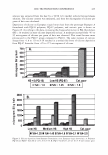
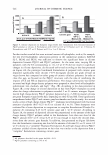
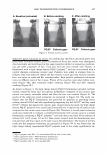
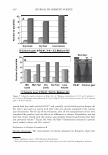
320 JOURNAL OF COSMETIC SCIENCE complex morphological structure composed of three components: the cuticle, the cortex, and the medulla (8). It is proposed that it is the cortex that is the significant contributor to the thermal stability of the fiber. The cortical structure has been described as being composed of the intermediate filaments (IFs), which have an a-helical structure, em- bedded inside an amorphous matrix containing the intermediate filament associated proteins (IFAPs) (9,10). As measured by the HPDSC technique, the denaturation en- thalpy (0HD) is proposed by Wortmann et al. (11) as being dependent on the structural rigidity of the a-helical material in the intermediate filaments. The peak temperature (TD) is controlled by the cross-link density and viscosity of the matrix in which the intermediate filaments are embedded. Several authors have specifically investigated the effect of multiple bleaching treatments on the HPDSC peak temperature and enthalpy. Wortmann et al. (12) showed a steady decrease in both BHD and TD with an increasing number of treatment cycles. Monteiro et al. (13) observed a similar trend. In both cases the decrease in 3HD and TD was linked to the oxidative cleavage of the cystine protein to form cysteic acid, with a decrease in inter-protein cross-linkage. In this present study we also look at the effect of multiple bleaching treatments on the HPDSC peak temperature and enthalpy, but we have also considered the role of the chassis formulation and its components on influencing the HPDSC results. Specifically, we studied treatments with the alkalizer alone (either ammonia or ethanolamine) buff- ered at pH 10, the same pH as a typical bleach product. The results from the HPDSC experiment were also compared to tensile strength measures such as plateau load and break force. The tensile strength method has also been reported to indicate the oxidative damage caused by bleach products (14-16). EXPERIMENT AL Caucasian untreated mixed hair (medium brown), obtained from a commercial source (IHIP, New York), was formed into swatches (16 cm, 1.5 g). The hair swatches were subjected to a number of repeat wash cycles between each treatment. One wash cycle consisted of two shampoo plus rinses in tap water with a commercial clarifying shampoo. The following products were used: • Bleach product A-alkaline solution of hydrogen peroxide, ammonium persulfate and ethanolamine (pH 10) in a gel formulation • Bleach product B-alkaline solution of hydrogen peroxide, ammonium persulfate and ammonium hydroxide (pH 10) in a gel formulation • Bleach product C-alkaline solution of hydrogen peroxide, ammonium persulfate and ammonium hydroxide (pH 10) in a cream formulation Dialysis of the hair was achieved by soaking in repeated changes of lliter deionised water for a total of 25 liters. The pH of the dialysed water was monitored for each change of deionised water. For treatment with the alkalizers two swatches were soaked in 100 ml of the alkalizer solution (1.27M) for 30 minutes at 30°C. The hair was washed twice with a clarifying shampoo before HPDSC analysis. HPDSC investigations were carried out using either: • A Dynamic Difference Calorimeter DSC 204 Phoenix supplied by the Netzsch Com- pany. The heating range was 90-l 70°C at a rate of 5 ° C I minute. Hair tresses were

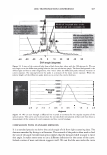
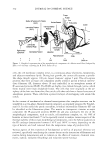
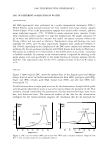
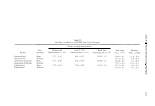
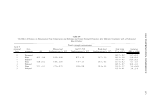
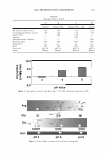
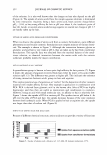
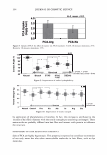
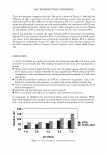
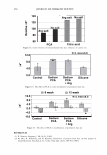
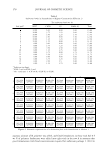
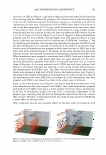
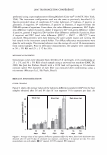
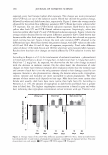
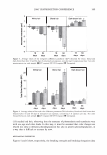
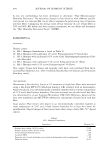
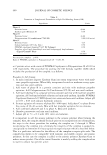
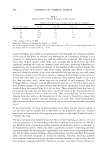
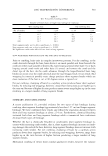
2006 TRI/PRINCETON CONFERENCE 321 cut into 2-3 mm lengths and conditioned overnight. The next day 10-12 mg of hair was placed under climate controlled conditions into a medium pressure 120 µl volume, steel crucible (Netzsch) with a lid and sealing elastomer, max pressure 20 bar max temperature 200°C. 50 µl of distilled water was added to the crucible which was then sealed. 4 replicates are used for each determination. • A Dynamic Difference Calorimeter DSC7 calibrated with indium supplied by Perkin Elmer. The heating range was 70-170°C at a rate of 10°C I minute. Hair tresses were conditioned for 24 hours at RH 55% and 22°C before samples were removed and cut into 0.5mm lengths. 4-7mg of hair was placed into a Perkin Elmer pan. 50µ1 of distilled water was added to the crucible which is then sealed. At least 3 replicates were used for each determination. The tensile properties of the fibres were measured using a Diastron Miniature tensile tester (MTT 675) equipped with laser micrometer. The color of the hair was measured with a bench top Minolta CM3600D spectropho- tometer. Lab values were calculated under D65 illuminant, 10° observer, specular in- cluded. The lightening (dL) was calculated as the difference in L value between the final color and the starting color on the untreated hair. RES UL TS AND DISCUSSION The results detail the effect on the HPDSC denaturation temperature and enthalpy following treatments with commercial retail bleach products A and B. Both products have three components: the alkalizer, the hydrogen peroxide, and the persulfate salt powder. These two products have the same level of oxidant (hydrogen peroxide and ammonium persulfate) and the formulations of these two components are very similar. However the formulations of the alkalizer components are different. Product A has a gel alkalizer formulation with ethanolamine as the alkalizer Product B has a liquid alkalizer formulation with ammonium hydroxide as the alkalizer. Three repeat treatments were performed with five wash cycles in between each treat- ment. After this treatment protocol the swatches were analysed for lightness vs. the starting substrate (dL), tensile strength and HPDSC peak temperature and enthalpy. Table I summarises the results of these analyses. For the HPDSC determination, the results show that both of the bleach products induce a decrease in peak temperature vs. the untreated hair as one would expect from previ- Table I The Effect of Treatments of Bleach Formulations on HPDSC and Tensile Strength Tensile strength measurements Plateau load Load@ 25% Break load Peak temp. Enthalpy dL after 3 Gmf/ sq .micron Gmf/sq.micron Gmf/sq.micron TD ± s LlHD ± s Product cycles (x 103) ( X 103) (x 103) (oC) 0/g) Untreated hair 0 6.47 ± 0.23 7.52 ± 0.23 20.9 ± 1.9 148.3 ± 0.1 6.7 ± 0.5 Bleach A 48 ± 0.6 4.00 ± 0.27 4.81 ± 0.34 16.5 ± 1.5 143.8 ± 0.8 5.8 ± 0.5 Bleach B 49 ± 0.5 4.12 ± 0.38 4.70 ± 0.45 16.5 ± 3.7 138.8 ± 0.3 5.1 ± 0.3
Purchased for the exclusive use of nofirst nolast (unknown)
From: SCC Media Library & Resource Center (library.scconline.org)