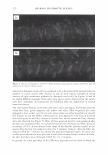
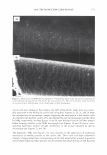
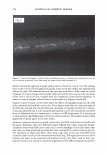
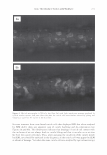
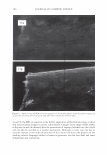
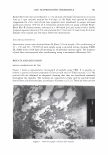
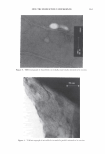
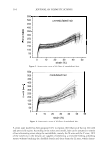
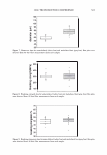
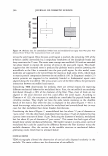
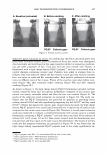
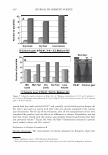
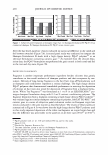
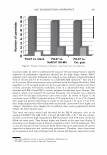
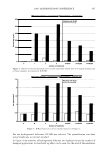
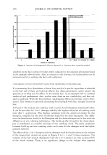
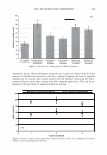
J. Cosmet. Sci. ! 58, 359-368 Quly/August 2007) Hair medulla morphology and mechanical properties RITA WAGNER and INES JOEKES, Departamento de Ffsico Qufmica! lnstituto de Qufmica! Universidade Estadual de Campinas! UN/CAMP! CP 6154, 13083-970! Campinas, SP, Brazil. Synopsis The morphology of human hair was extensively discussed in the last century, except for hair medulla, mainly because it was believed to have little or no influence on any useful hair property. Early SEM results showed that medulla is formed by unorganized fibrilar material that could be macrofibrils randomly located in the fiber center. The present paper aims to correlate the fibrilar structures with the macrofibrils using trans- mission electron microscopy (TEM) and to evaluate the influence of medulla on the mechanical properties of hair. TEM micrographs show that the interface between cortex and medulla is surrounded by a CMC layer and that there is less electronically dense material between cortical cells. Cortical cells in medulla give the usual microfibril crystalline arrangement. The cells become scarce and less organized in the center of the medulla, which also shows air filled granules. Average values of the mechanical properties are similar for unmedullated and medullated fibers. However higher dispersion in data for medullated fibers is observed. Unmedulated fibers are more uniform and show smaller diameters. These data indicate that the air cavities in medulla do not interfere with the mechanical properties, but leave hair strength less uniform. INTRODUCTION Human hair morphology has been extensively discussed in recent decades due to the interest of the cosmetic industry and the dermatological and forensic sciences (1). With advances in microscopic techniques, it is possible to obtain additional physical and chemical information about morphological hair structures, using atomic force micros- copy (AFM) or image mass spectrometry, for example (2,3). Despite more difficult sample preparation methods, the classical electron microscopy techniques (TEM and SEM) are still very much used to study human hair morphology (4,5) mainly because of their resolutions. Human hair is composed mainly of a-keratin (- 80% w/w), which is an a-helical protein with high cystine content (6,7). Morphologically, human hair is divided into four units: cortex, cuticle, intercellular material and medulla the medulla is not always present. The cuticle has an amorphous character. Each cuticle cell is formed by 4 subunits that have distinct chemical compositions and reactivities. Their cross-linked structure de- pends on the cystine content. (8,9). The cell membrane complex (CMC), which is found between the cuticle cells, is a hydrophilic material rich in polar amino acids and lysine 359

360 JOURNAL OF COSMETIC SCIENCE (2% w/w cystine) (10,11). CMC and endocuticle are believed to be the main diffusion pathways into human hair (12,13). The cortex is formed by elongated cortical cells surrounded by the CMC. The cortical cell (-100 µm long and 3 µm wide) has an inner fibrillar structure (macrofibrils of 0.4 µm diameter formed by the intermediate filaments of -10 nm diameter) embedded in a hydrophilic sulphur-rich matrix (12). This well-defined structure gives rise to out- standing mechanical properties (14). The medulla is located in the centre of the fibre and may be absent, fragmented or continuous (15). It is amorphous and has a high lipid content com pared to the rest of the fibre (16). Morphologically, it has been reported that medulla has a porous structure formed by "spongy" keratin (17 ,18) and some vacuoles filled with air resulting from the differentiation process (17, 19). A layer of CMC separates the medulla from the cortex (20). Nevertheless, some authors say that the medulla is just those vacuoles or granules and that the porous structure is formed by an unidentified material (17 ,20). Medulla represents about 20% of the total fibre section. The effects of this porous structure on mechanical properties are still unknown. The cuticle subunits were first studied by TEM (21). In TEM, the contrast is created by staining the sliced sample to obtain a two dimensional image. Human hair has to be embedded in a resin to be sliced in an ultramicrotome, otherwise the ultrastructure is not differentiated. In the case of medulla observations, preserving the porous structure and the CMC layer is also difficult. This paper aims to identify the microfibrils in the medulla by TEM and relate their structures to the mechanical properties. MATERIALS AND METHODS A one-head tress was observed in a stereoscope and separated into bundles of 40 fibers with or without medulla. HAIR SAMPLES A Caucasian dark brown hair sample was obtained from a female donor and separated in medullated and unmedullated fibers using a stereo-microscope. This procedure elimi- nates chemical and morphological differences by genetics or cosmetic treatments since all fibers come from the same scalp. TEM OBSERVATIONS TEM micrographs were obtained in a Philips CM200 microscope, operating at 160 kV. One cm segments of hair fibers were fixed using 2 ml of 2% (v/v) OsO4 (Sigma) in 0.1 mol L - 1 sodium cacodilate buffer at pH 7, for 4 h in the dark, followed by washing in water or buffer for 30 min. The segments were dehydrated with a series of ethanol solutions of increasing concentration (from 50 to 100%, v/v), for 15 min, two times with each one of the solutions. Then, the hair was exposed twice to a solution of 100% ethanol for 5 min. Spurr resin (standard formulation of low hardening rate, 0.2 g catalyst) used as embedding media, in the following steps: (a) hair segments were placed in closed
Purchased for the exclusive use of nofirst nolast (unknown)
From: SCC Media Library & Resource Center (library.scconline.org)