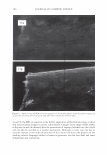
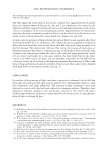
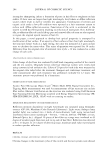
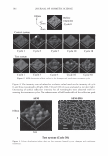
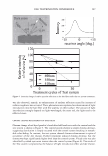
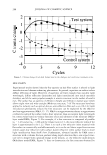
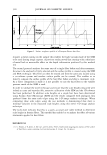
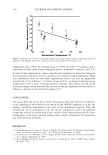
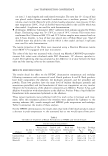
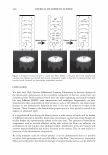
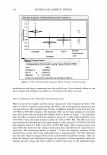
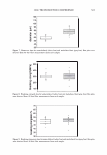
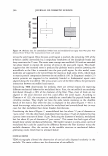
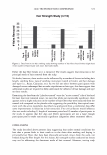
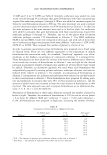
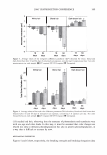
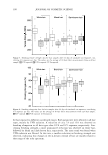
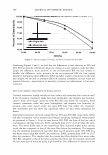
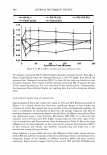
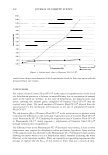
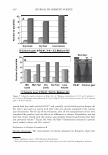
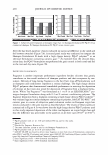
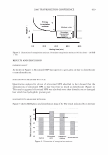
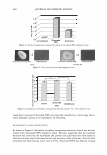
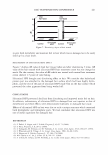
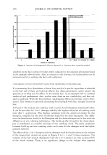
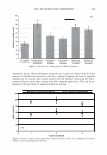
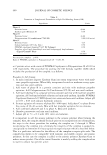
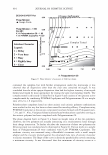
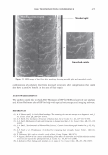
418 JOURNAL OF COSMETIC SCIENCE 13.00 12.00 11.00 +------------- 10.00 +--------- - 9.00 � 8.00 c -m 7.00 8 6.00 +------- Q) a:: 5.00 4.00 ·+------ 5 10 15 % Phoenomulse CE-1 / Figure 3. Sodium lauryl sulfate vs Planteran 2000 N UP®. 20 25 ........ Sodium Lauryl Sulfate -Planteran 2000 results from subjective evaluations of the formulations tested for foam rate agree with the measured foam rate results. CONCLUSIONS The release of some Cosmetic Fluid CF-61 ® at the surface is hypothesized to be the result of a dehydration process or a decrease in water efficiency due to evaporation of external water at the liquid-air interface. In this state of dehydration, the nanostructures may invert, releasing the internal phase, comprised of Cosmetic Fluid CF-61 ® into the external water phase. The small amounts of Cosmetic Fluid CF-61 ® released from the nanostructure by this mechanism will evaporate at the rate of unstabalized Cosmetic Fluid CF-61 ®. The stabilization effect of Cosmetic Fluid CF-61 ® in the nanostructure is apparent when comparing the differences in the individual evaporation rates of Cosmetic Fluid CF-61 ® verses Phoenomulse CE-1 ®. Comparing the evaporation rates of Cosmetic Fluid CF-61 ® to Phoenomulse CE-1 ® clearly supports a stabilization of Cosmetic Fluid CF-61 ® through nanostructure encapsulation. The differences seen in the Phoenomulse CE-1 ®!deionized water system, at least at room temperature, may support the dehydration release mechanism hypothesis. Some settling of the nanostructures was observed in the Phoenomusle CE-1 ®/deinonized water system, allowing the excess water to act as a dehydration shield, therefore increasing the water efficiency at the liquid-air interface. There are currently no supporting experiments that attempt to explain why the Kevap of this system is lower than just a system of dein-

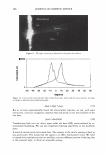
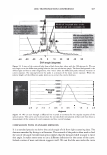
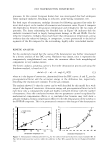
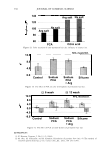
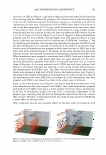
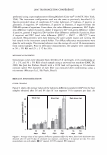
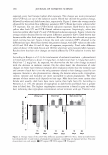
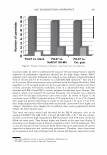
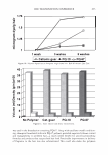
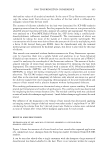
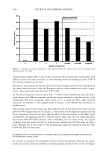
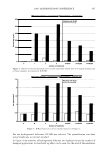
2006 TRI/PRINCETON CONFERENCE 419 ionized water. A probable hypothesis may be that the Phoenomulse CE-1 ® is responsible for some hydrogen bonding which may be lowering the Kevap of the external phase. This phenomenon provides an opportunity for continued research. Once the Cosmetic Fluid CF-61 ® from FBT formulations containing surfactant evapo- rates at the surface, foam is produced, creating an active foaming product. Since the release of the cosmetic fluid occurs only at the liquid-air interface, only a fraction of Cosmetic Fluid CF-61 ® is released at any given time. While this certainly enhances the positive foam attributes of the formulation, it also creates challenges when quantifying the foam of any given formulation. Formulation modifications which affect the water efficiency at the liquid-air interface, will also affect initial foam quantity, and ultimately foaming performance. This is supported when observing the changes in foam rates at different saccharide hydrosalate levels (Figure 2). Foam rate increase observations in formulations with lower water efficiency at the liquid-air interface may also support the release mechanism hypothesis. The rate of nanostructure disruption directly affects foam rate, and ultimately, foam performance. Foam rate measurements utilizing the in vitro test method developed for the use of this work can be a valuable aid when determining Phoenomulse CE-1 ® levels during FBT formulation navigation and formulation performance optimization. Determination of Phoenomulse CE-1 ® levels in formulations which contain naturally-based detergents whose foaming performance must equal that of SLS can be achieved with good accuracy. An example is demonstrated when observing similar initial foam generation rates of 5% SLS with 1-5% Phoenomulse CE-1 ® to formulations containing 5 % Planteran 2000 N UP® with 15% Phoenomulse CE-1 ® (Figure 3). Subjective evaluations of these two formulations suggest similar foaming performance. REFERENCES (1) T. Harding, Perception of foam: Are there alternatives to SLES? Proceedings of the Australian Society of Cosmetic Chemists (ASCC), 37th Annual Conference (Cosmetics on a New Horizon), March 13-16, 2003, Hamilton Island, Queensland, Australia, CD-ROM, paper 11, pages 1-6. (2) C. M. Persson, P. M. Claesson, and I. Johansson, Interfacial behavior of n-octyl beta-D- glucopyranoside compared to that of a technical mixture consisting of octyl glucosides, Langmuir, 16, (26) (2000). (3) K. Klein, Evaluating shampoo foam, Cosmet. Toiletr. 119 (10), 32-35 (2004). (4) M. Krzan, K. Lunkenheimer, and K. Malysa, Surfactant's polar group on the local and terminal velocities of bubbles, Colloids Su/ A: Physicochem, 250 (1-3), 431-441 (2004). (5) B. Salka, Polyglycosides properties and applications, Cosmet. Toiletr., 108(3), 89-94 (1993).
Purchased for the exclusive use of nofirst nolast (unknown)
From: SCC Media Library & Resource Center (library.scconline.org)