476 JOURNAL OF COSMETIC SCIENCE (9) R. McMullen and J. Jachowicz, Thermal degradation of hair. I. Effects of curling irons,]. Cosmet. Sci., 49, 223-244 (1998). (10) D. C. Streuli, L. C. Foltis, and N. Clements, Style savers, Global Cosmet. Ind. Mag., 30-32 Qanuary 2002). (11) S. S. Sandhu and C. R. Robbins, A simple and sensitive technique, based on protein loss measurements, to assess surface damage to human hair,]. Soc. Cosmet. Chem., 44, 163-175 (1993). (12) N. Karibyants et al., Characterization of PSS/PDADMAC-co-AA polyelectrolyte complexes and their stoichiometry using analytical ultracentrifugation, Macromolecules, 30, 7803-7809 (1997). (13) P. Ramachandran et al., WO96/32920, assigned to Colgate, Oct. 24, 1996. (14) E. Tsuchida et al., Die Makromolekulare Chemie, 175, 583-591 (1974). (15) Design Expert 6, Stat-Ease, Inc., 2021 East Hennepin Ave., Minneapolis MN 55413 (2003). (16) C.R. Robbins, Chemical and Physical Behavior of Human Hair, 3rd ed., (Springer-Verlag, New York, 1994). (17) S. E. Kelly and V. N. E. Robinson, The effect of grooming of the hair cuticle,]. Soc. Cosmet. Chem. 33, 203-215 (1982). (18) S. B. Ruetsch and Y. K. Karnath, Change in surface chemistry of the cuticle of human hair by chemical and photochemical oxidation, IFSCC Mag., 7(4), 209-307 (2004). (19) M. Joy and D. M. Lewis, The use of FTIR spectroscopy in the study of the surface chemistry of hair fibres, Int.]. Cosmet. Sci., 13, 249-261 (1991). (20) Y. K. Karnath, C. J. Dansizer, and H. D. Weigmann, Wettability of keratin fiber surfaces, ]. Soc. Cosmet. Chem., 28, 273-284 (1977). (21) H-D Weigmann and Y. K. Karnath, Modification of human hair through fiber surface treatments: Characterization by wettability, Cosmet. Toiletr., 101, (1986).

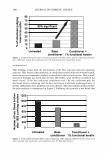
J. Cosmet. Sci.! 58, 477-484 CTuly/August 2007) Hair breakage during combing. Ill. The effects of bleaching and conditioning on short and long segment breakage by wet and dry combing of tresses CLARENCE ROBBINS and YASH KAMATH, 12425 Lake Ridge Circle, Clermont, FL, 34711 (C.R.), and Textile Research Institute, PO Box 6251 Princeton, NJ 08540 (Y.K.). Synopsis A recent publication (1), provided evidence for two types of hair breakage during combing, short segment breakage (approximately less than 1.27 cm) and longer segment breakage. We have confirmed these results and refined the separation distance between short and long segment breakage at about 2.54 cm. Further- more, chemical bleaching increased both short and long segment breakage while a commercial hair con- ditioner decreased both types of breakage. Whether the hair is chemically bleached or conditioned, for dry combing, short segment breakage increases with increasing comb strokes, that is, short segment breakage increases as combing damages the ends of the hair, however, long segment breakage does not increase with increasing comb strokes. Wet combing provided a decrease in short segment breakage and an increase in long segment breaks, but no increase in breakage with increasing comb strokes. Mechanical combing of tresses shows similar results qualitatively, however the variance was too large and adjustments need to be made to provide for a larger number of broken hairs to bring the mechanical and hand combing results in line. For dry combing, as the comb descends through the hair, hairs above it are made parallel and those beneath are either made parallel or knot by, hairs looping around other haits or hairs looping around comb teeth and other hairs several cm between the comb and the hair tips. As the comb advances through the looped/ knotted hairs long breaks occur or as the comb descends near the tips wrapped ends can result. End wrapping by inertia & possibly static charge produces short segment breaks which are more severe if the hair is cut at 90 degrees versus a tapered cut. For wet combing, clumping of hairs by a capillary action produces fewer short segment breaks, by reducing end wrapping however, crossed hair interactions occur & because of higher friction more severe snags arise higher up in the tress, and lower hair breaking load due to plasticization by water, producing a larger number of long segment breaks. The very best practical way to evaluate hair strength is by counting the actual number of short and long segment breaks and by considering both wet and dry combing. INTRODUCTION In a previous paper (1), it was demonstrated that during hand combing of hair, short fiber fragmentation (less than about 1.27 cm) and longer segment breakage occurs by different pathways. It was proposed that longer segment breaks occur primarily by 477
Purchased for the exclusive use of nofirst nolast (unknown)
From: SCC Media Library & Resource Center (library.scconline.org)