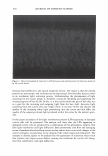
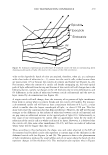
]. Cosmet. Sci. 1 58, 311-317 Quly/August 2007) Fundamental DSC investigations of a-keratinous materials as basis for the interpretation of specific effects of chemical, cosmetic treatments on human hair F.-J. WORTMANN, G. SENDELBACH, and C. POPESCU, University of Manchester, School of Materials, P.O. Box 88, Manchester M60 JQD, UK (F.-j. W.), Wella Service GmbH, Berliner Allee 65, D-64274 Darmstadt, Germany (G.S.), and DWI at RWTH Aachen University, Pauwelsstrasse 8, D-52074 Aachen, Germany (C.P). Synopsis a-keratinous materials can be considered as two-phase, filament/matrix composites, in which partly crys- talline, a-helical intermediate filaments (IF) are embedded in an amorphous matrix of IF-associated proteins (IFAP). Differential Scanning Calorimetry (DSC) of keratins in water was found to be especially suited to analyze various aspects of the thermal stability of these main morphological components. Results and considerations are reviewed, which were gained by applying the principles derived from fundamental investigations to the specific effects of oxidation (bleaching) and reduction (perm-waving). Properties and interactions of the main morphological components of human hair are considered that are specifically related to the various aspects of their thermal stability. The overall view of the results shows that the course of the thermal unfolding of the a-helix in the IFs is independent of the chemical history of hair. The matrix properties are the primary factor controlling the kinetics of the onset of the denaturation process in the IF/IF AP-composite. INTRODUCTION Hair, such as animal or human hair, grows in various types on all parts of the body and from cavities in the skin, called follicles, which are embedded up to 3 mm deep in the dermis and extend to the surface of the skin through the epidermis and the stratum corneum (1). During its growth the hair fiber, in the same way as other a-keratin materials, such as hoof, horn, and quill, develops complex morphological fine structures (2). Figure 1 shows a graphical representation of the structure of a wool fiber, as possibly the best investigated a-keratin hair fiber (3 ,4). A hair fiber is constituted of cells that differentiate during hair growth to form, namely, the fiber core (cortex) and an outer protective layer (cuticle). The interface between the Presented in specific part at the 34th Annual Conference of the North American Thermal Analysis Society, August 2006, Bowling Green, KY. Address all correspondence to F.-J. Wortmann. 311

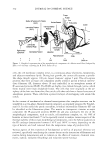
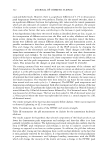
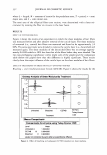
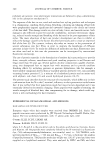
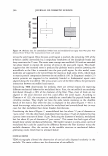
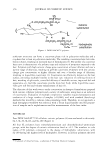
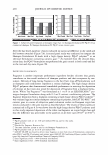
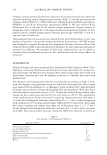
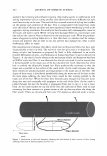
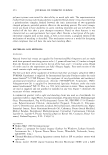
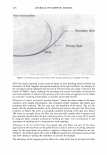
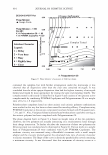
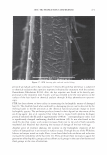
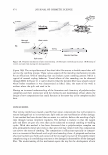
312 Right-handed alpha-Helix JOURNAL OF COSMETIC SCIENCE Sulphur & Tyrosine-rich Proteins (KA-P) Nuclear Remant Low-sulphur Proteins (KIF-P) lntermacrofibrillar Material Intermediate Filament Macrofibril F-Layer A-Layer I, Para- Exo Endo-cuticle Para-cortical Cell Cortex I 200 I 2000 Cuticle I 20000 nm Figure 1. Graphical representation of the morphological components of a Merino wool fibre (Adapted by Zahn et al. (4) from a drawing by R. D. B. Fraser 1972). cells, the cell membrane complex (cmc), is a continuous phase of proteins, lipoproteins, and adjacent membrane lipids. During hair growth, the cortex cells assume a spindle- like shape (length: approx. 100 µm, largest diameter: approx 5 µm). The cells express proteins that form as major cell component axially oriented, partial a-helical interme- diate filaments (IF, diameter about 10 nm) embedded in an amorphous matrix of IF-associated proteins (IFAP). The IFAPs are highly cross-linked through cystine, which forms mainly inter-chain disulphide bonds. The cells that were originally at the pe- riphery of the hair root form thin, flat cuticle cells that each have a layered structure of amorphous proteins. These cells form a protective layer of overlapping cells around the cortex. In the context of mechanical or thermal investigations this complex structure can be simplified as a two-phase, filament/matrix composite, as originally proposed by Feughel- man (5 ). In this model the partly crystalline, a-helical intermediate filaments (IF) can be identified as the filamentous phase. The matrix in consequence contains as major component the IF-associated proteins (IFAP) (6) and also summarily the rest of the morphological components, such as cuticle, cell membrane complex, etc. ( 4). DSC of keratins in water was found (7) to be especially suited to analyze various aspects of the thermal stability of these main morphological components, since the helical segments in the IFs undergo denaturation between l 10°C and 160°C in water, depending on the type of keratin, and well removed from the temperature range of pyrolysis (8,9). Various aspects of this transition of fundamental as well as of practical relevance are reviewed, specifically considering the current theory on the interaction of filaments and matrix during denaturation and its relation to the effects of cosmetic, chemical treat- ments, namely, oxidation (bleaching) and reduction (perm-waving).
Purchased for the exclusive use of nofirst nolast (unknown)
From: SCC Media Library & Resource Center (library.scconline.org)